Mothering from the Field by Bahiyyah M. Muhammad Melanie-Angela Neuilly
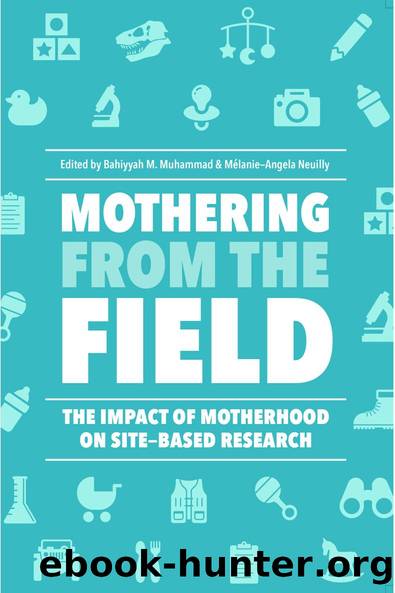
Author:Bahiyyah M. Muhammad, Melanie-Angela Neuilly [Bahiyyah M. Muhammad, Melanie-Angela Neuilly]
Language: eng
Format: epub
ISBN: 9781978800571
Goodreads: 41743766
Publisher: Rutgers University Press
Published: 2019-06-14T00:00:00+00:00
Subverting the Patriarchal Ethnographic Framework
Considering the ethnographic observation continuum reminds us that those of us who go deep and turn their research into their lives embody a specific type of work ethic: one that is only possible when there are no other responsibilities in oneâs life (in my case, when I was younger) or in a patriarchal system when one (usually a man) can rely on a support system (wife, assistants, etc.) to take care of all other responsibilities. Field research in the social sciences has been shaped by this approach, going back to the origins of ethnographic work in modern anthropology, with Franz Boas and his study of Alaskan Natives (1888) or Bronislaw Malinowski in the Trobriand Islands (1922, 1929, 1935), or in contemporary sociology, particularly with the Chicago School, but also, of course, with Erving Goffman and his participant observation of psychiatric wards (1961), or Howard Beckerâs study of drug users (1973), to name a few. We see such approaches continue to dominate todayâs ethnographic scene, with high profile worksâin chronological orderâby Philippe Bourgois (In Search of Respect: Selling Crack in El Barrio, 1995), Sudhir Venkatesh (Gang Leader for a Day: A Rogue Sociologist Takes to the Streets, 2008), Alice Goffman (On the Run: Fugitive Life in an American City, 2014), and Matthew Desmond (Evicted: Poverty and Profit in the American City, 2016) despite some of them being questioned on grounds of ethical or methodological soundness.
So while qualitative research has typically been seen as a way for researchers to turn their backs on a reifying and oppressive positivist methodological paradigm (Law, 2004; Pascale, 2001; Sprague, 2016), a lot of the examples of ethnographic research we glorify rest on the very system at the basis of the rejected paradigm. As such, I want to propose that despite (or maybe because of) all the guilt I experienced as a result of not being able to shut the rest of the world off and dive deep into my research site, my careful observations conducted from nine to five, with a lunch break in the middle, and then put to rest until the next morning after being meticulously journaled on the bus ride home every day are no less valuable than those observations I conducted when I was twenty-seven, staying up for twenty-some hours in order to stay for back-to-back shifts and then going to the bar for my daily âdebriefing.â
How is it then that I and many other field researchers (and also academics who do not conduct field research, nonacademic professional women, and just basically everybody else) see motherhood as a limitation or a constraint? We hide it, deemphasize it, do everything in our power to minimize its âimpactâ on our work, and yet there is power in our motherhood. Indeed, what this has taught me is that far from a constraint or a limitation in research, motherhood is a standpoint. Understanding and accepting that has allowed me not only to better journal my experience in Nice but also to look
Download
This site does not store any files on its server. We only index and link to content provided by other sites. Please contact the content providers to delete copyright contents if any and email us, we'll remove relevant links or contents immediately.
Cecilia; Or, Memoirs of an Heiress — Volume 1 by Fanny Burney(32558)
The Great Music City by Andrea Baker(32019)
Cecilia; Or, Memoirs of an Heiress — Volume 2 by Fanny Burney(31956)
Cecilia; Or, Memoirs of an Heiress — Volume 3 by Fanny Burney(31942)
We're Going to Need More Wine by Gabrielle Union(19046)
All the Missing Girls by Megan Miranda(16028)
Pimp by Iceberg Slim(14507)
For the Love of Europe by Rick Steves(14121)
Bombshells: Glamour Girls of a Lifetime by Sullivan Steve(14075)
Talking to Strangers by Malcolm Gladwell(13370)
Norse Mythology by Gaiman Neil(13365)
Fifty Shades Freed by E L James(13241)
Mindhunter: Inside the FBI's Elite Serial Crime Unit by John E. Douglas & Mark Olshaker(9343)
Crazy Rich Asians by Kevin Kwan(9292)
The Lost Art of Listening by Michael P. Nichols(7506)
Enlightenment Now: The Case for Reason, Science, Humanism, and Progress by Steven Pinker(7313)
The Four Agreements by Don Miguel Ruiz(6765)
Bad Blood by John Carreyrou(6621)
Weapons of Math Destruction by Cathy O'Neil(6280)
